Gabriela Salazar
Proyecto #3


Gabriela Salazar
(Nueva York, 1981)
The invitation to write implies a displacement: from the material space to the space of language. What kind of openness or resistance did you find in that transit?
I feel that language is also material. Since I was a teenager I have journaled, and it’s become a semi-automatic process of letting one idea or thought follow the last without worrying about overall sense at all, stopping mid-sentence or idea or just repeating a word over and over. On the other hand, when I write for another reader, I edit and write simultaneously, cutting and pasting, moving, shifting bits and pieces around, adding and subtracting, trying different relationships until the sense I want starts to be constructed. Both approaches have parallels in my art studio practice, and I also often do a lot of writing in the planning stages of making art. It can be easier to toss about than expensive or precious materials. Language feels like a part of the same universe I make in, or better; a moon that is always in orbit around it, pushing and pulling the tides.
Is there a link between the text you wrote and your work, or do you prefer to think of it as an independent gesture?
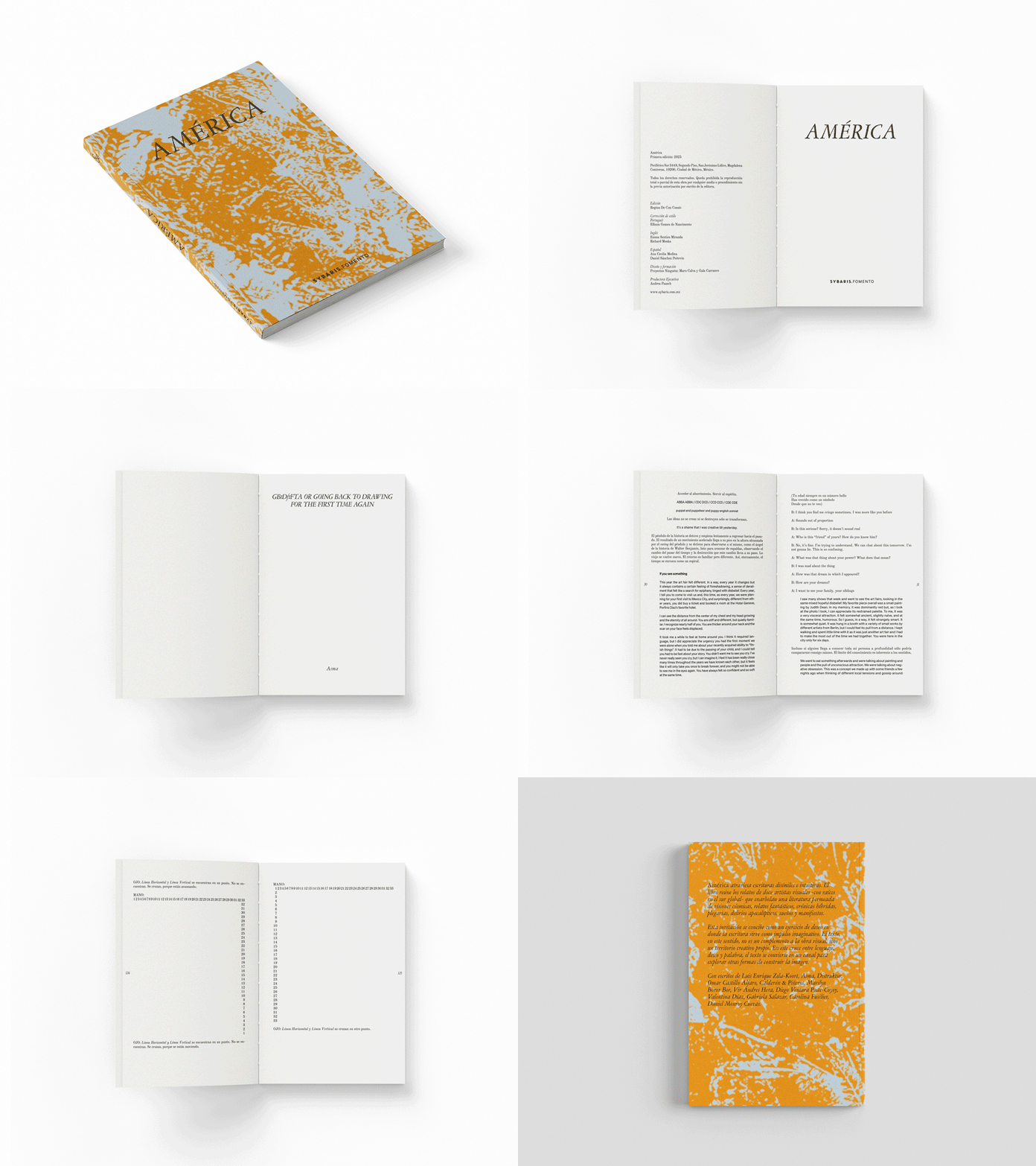
“Observed” is also the title I gave to a series of 365 small, daily, observational pen drawings I made in 2023. Committing myself to a years-long routine of careful observation, and the friction and flow of translating it to paper, was very grounding for me. (Though I also felt a relief when the year was over.) The writing I did for the anthology feels like a channeling of that earlier work. Like delimited looking is a tool, but instead of ink and paper here I applied it to a different material, a different spectrum of experiences, coming from a different place and time in my life.
What place does fiction (or the poetic) occupy in your way of thinking about art and the world?
In my sculptural and drawing work I’m often using known objects and their associations (a window, a handrail, a wedge, a hand, a velvet rope, a brick, a hinge), and setting it up in unexpected situations or materials, or swapping materials intentionally (coffee for concrete, water-soluble paper for the more durable) to bring in the new material’s associations. There’s a way to see this as a type of fiction building, of leaning on the known and experienced to set the viewer up for a deeper understanding of what they thought they already knew well.
In this exercise where written language has become your main subject of work, do you think of writing as a space of freedom or as a zone of restriction?
I don’t think of writing as either freedom or restriction—there are some of both feelings in the process. I prefer to consider it as a spectrum of limits, again, like physical material, it has properties. Some combinations of words and sentences strain the ability of sense, and then, can make new sense—or fall apart. There’s balance, and a kind of activation of gravity—like within a game of tetris, or when gingko leaves drop all at once after the first frost—as words are added and the text drops down into the white rectangle. Writing behaves differently when I write in the studio, when I make the shapes of letters, the words go all over the page, get crossed, circled, underlined, they become maps and nets and trees and sometimes walls. Again, a materiality permeates the act of writing itself.
The anthology is committed to slowing down, to giving time to the word. In a present saturated with images and speed, what does it mean to stop and write?
Yes, slowing down is incredibly hard! It occurs to me that despite the slowing down to look closely, to describe carefully, perhaps there’s something of the genre of social media in it. “Observed (April 23 – May 7, 2025)” is organized as a sequence of scenes, (described) images, some still and some moving. One could make the argument that it’s a version of a (granted, pretty boring) social media feed…. But maybe I am just amusing myself with the parallels because the speed and onslaught of images of our contemporary lives feels indeterminable. As much as writing can take me out of that scrum for a while, it also feels like the gaps between cars in a fast-moving train. Brief, fleeting, hard to make out for the hurtling inertia of the rest.
What do you hope the reader will find in your text?
I hope that they’ll be a friend, sit with me a bit, and look through my window. I wrote this while going through a difficult time, anticipating grief, holding a lot of sadness. But perhaps I’m less alone than I felt and the reader will make time and we can look together, be together, seeing what I saw.